
 LinkedIn
Two search operators can look at the same AI Overview and send you opposite invoices. Is getting cited just good SEO, or does AEO require a different job? Smart people disagree because ranking gets pages into Google’s orbit, yet a high-ranking page can still lose the citation to a clearer answer farther down the results. My verdict turns on one testable thing: whether your page contains a passage that answers the question on its own.
The money behind the argument is real. If AEO is SEO in a new jacket, a stand-alone AI search retainer may charge you again for work you already bought. If ranking alone is not enough, an agency that reports positions once a month can call a page a success while a competitor gets quoted above it. Neither invoice tells you what happened on the page.
The SEO case: Google has to find and trust you first
The strongest advocate for the “just do good SEO” position is Google itself. At an official Search Central event, search engineer Gary Illyes said publishers do not need dedicated GEO or LLMO programmes. His advice was to “simply use normal SEO practices”; he also said Google does not use custom files such as llms.txt. Before Google can draw on a page for an answer, it needs to discover and index that page. No amount of prompt tracking rescues a URL the search engine cannot reach.
The overlap with ordinary search results is substantial. BrightEdge found that 54% of Google AI Overview citations match URLs in the top organic results. That is a strong argument against treating AI visibility as a detached channel with its own magic switch. Google’s existing search systems already know a great deal about which pages cover a topic. If your site has little organic visibility, buying a citation dashboard does not give Google a reason to surface it.
The technical work looks familiar, too: accessible pages, clean responses, readable HTML, sensible headings and internal links that help Google understand what belongs together. Relevant links and third-party references help establish credibility. Crawlability and authority are not optional preliminaries to AEO; they are part of the job. An agency pitching a proprietary “GEO algorithm” while leaving crawl errors and inaccessible product copy untouched has started at the wrong end of the problem.
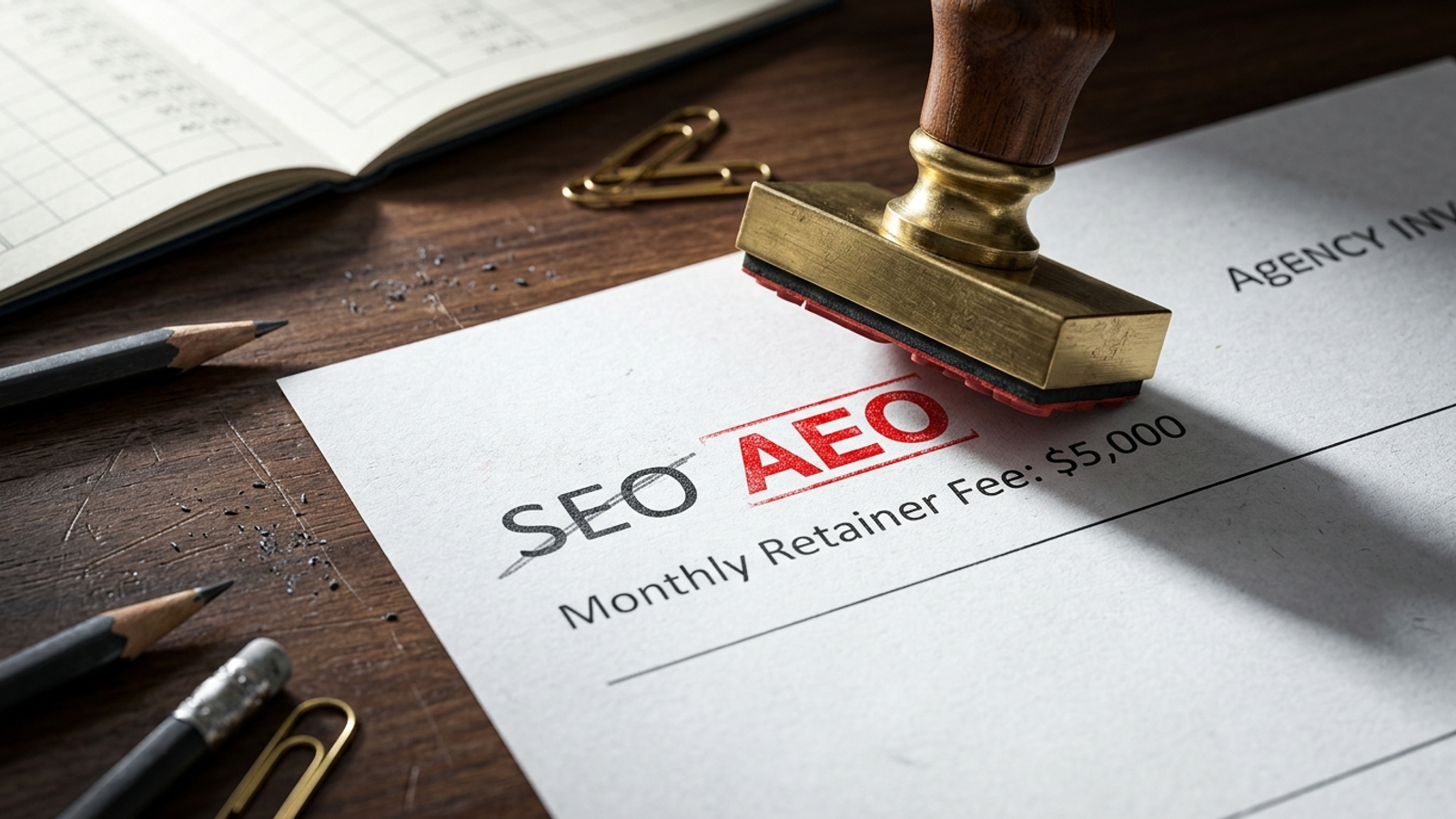
Then there is the invoice. I have watched search agencies turn feature changes into fresh line items before: give the update a name, announce that the old rules no longer apply, and bill for a new programme whose deliverables look suspiciously like the existing one. A retainer for “synthetic prompt preparation” is not impressive if it buys basic FAQ edits, meta-description tweaks and someone manually checking results. Call that search work. Do not pay twice because the slide deck has a new acronym.
If you cannot be found, fix the search foundation before buying an AI-search speciality. That is the SEO camp’s best argument, and it deserves more than a shrug.
The AEO case: a ranking is not a quotation
Now give the other side its strongest point. If AI Overviews simply mirrored organic rankings, the number-one result would routinely supply the answer. Onely’s ZipTie.dev data puts the AI Overview citation rate for the number-one organic position at 22%. Ahrefs data also indicates that roughly 60% of citations come from outside the top 10 organic results. A ranking report can therefore tell you where a document sits without telling you whether Google quotes it.
Here is the useful distinction: a page can rank for a topic while failing to state the answer in a passage Google can lift. Traditional content marketing rewarded the sprawling ultimate guide: history, definitions, context, three screens of scene-setting, then the thing the reader asked for. An AI Overview has a narrower task. It needs text that resolves the question clearly enough to use in a response. Contently’s research on passage extraction found that more than 44% of citations came from the first 30% of a page’s body text. It also found that direct, roughly 40-to-60-word answer passages performed better than qualifier-heavy prose. Placement and wording are no longer just matters of how patiently a human will scroll.
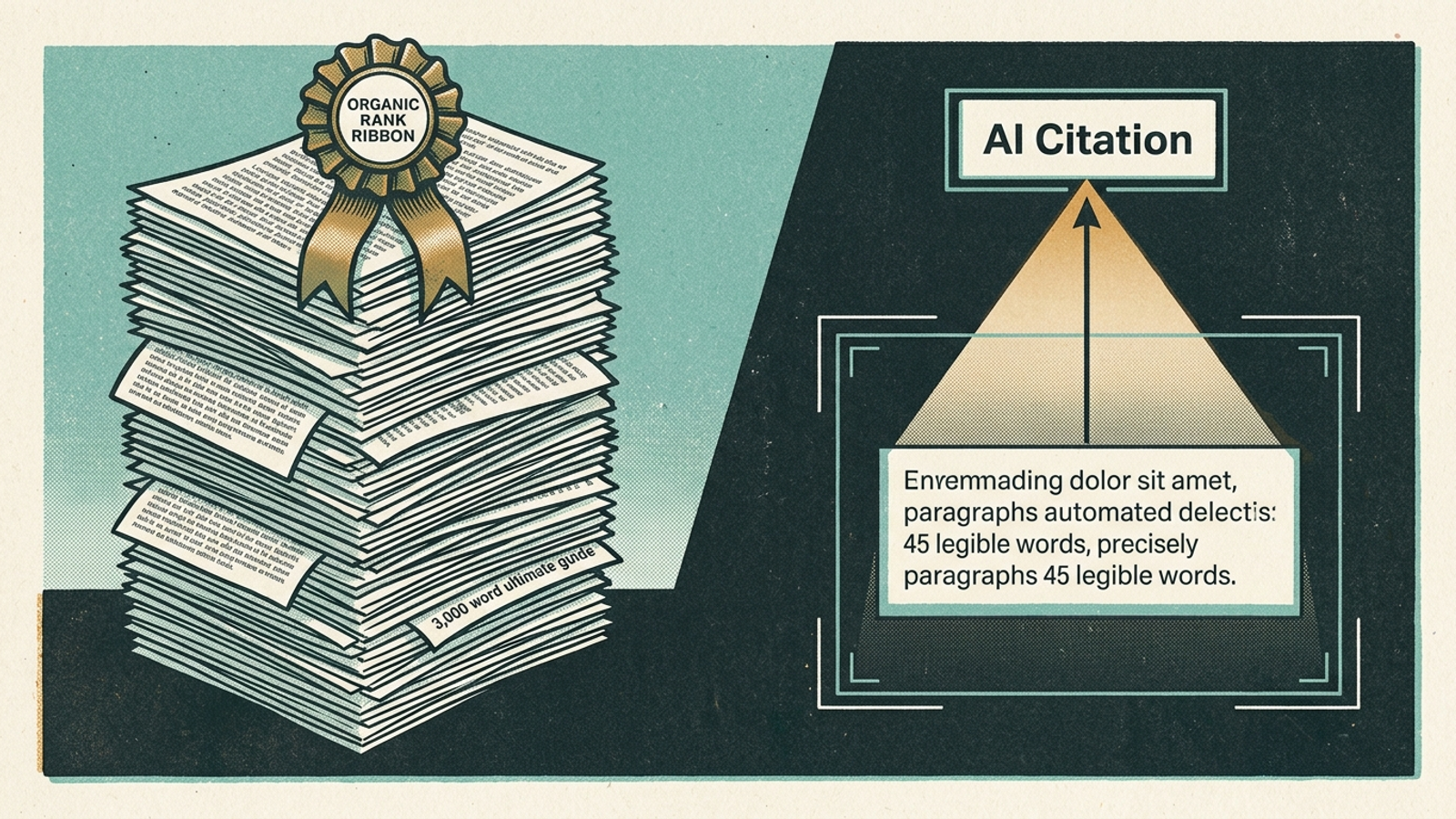
Search practitioners describe holding positions one or two while missing the AI Overview. That is not proof that every missing citation has the same cause. It is a reason to open the page rather than celebrate the rank. An authoritative article can still make the reader assemble an answer from scattered paragraphs. A less prominent page may state the same point plainly in three sentences under a relevant heading. For the overview’s immediate purpose, that passage is easier to use.
A clear passage is not the only consideration. AI visibility can reflect what the wider web says about an entity, not just what a page says about itself. In an analysis of 75,000 brands, Ahrefs found a stronger correlation between third-party brand mentions and AI Overview visibility (0.664) than between backlinks and that visibility (0.218). Agency operators also point to entity clarity and external validation when discussing sites that are not being cited. A neat answer on your own site does not make every assertion credible by itself.
Nor can Google use text it cannot readily access. If the essential product explanation sits behind client-side rendering, an unrendered accordion or a blocking firewall, the wording may never get a fair chance. Tools such as Screaming Frog, Sitebulb and Google Search Console can help identify indexation, schema and rendering problems. But a diagnostic export is not a repaired page. Someone still has to turn the finding into an accessible answer.
That is the AEO camp’s best case. Being eligible to appear and being useful to quote are different outcomes. Track the second one, or your tidy ranking report may hide the loss.
Put the two cases against the same page
Strip away the vendor language and the disagreement becomes easier to see. Imagine a B2B software firm ranking second for a pricing query. Its 4,000-word page has thirty authoritative backlinks, but it spends three screens on company philosophy before it reaches the price tiers. Classic search management marks the keyword green. When a buyer asks Google what the product costs, though, the overview cites a competitor at position seven whose page states the price in one short paragraph under a relevant H2. In this example, the firm’s ranking got its page into contention. The missing answer passage cost it the quotation.
Now reverse it. A specialist consultancy sits at position fourteen for an infrastructure query, where ordinary organic clicks are scarce. Its page contains a direct answer to the precise nuance of the prompt, and independent references support the claim. It appears among the overview’s citations. A position-fourteen result has not somehow defeated the value of SEO; it has shown that the order of blue links does not settle every citation decision.
This matters beyond the satisfaction of appearing in a box. In a study of 5.47 million queries, Seer Interactive found that cited pages received more clicks than uncited organic listings on the same results page. An uncited top-ranking page can lose attention to a lower-ranking cited one. The useful question is not whether your agency calls the work SEO or AEO. It is whether a buyer’s question has a clear, accessible answer on your page.
My verdict: edit for the answer, not the acronym
I would not buy AEO as a separate discipline. I would not tell a business to “just rank” and ignore what Google can extract, either. The deciding consideration is the standalone answer passage. SEO gives your page a credible shot at being found; passage editing gives a specific question a clear answer on that page. For a business already earning relevant rankings, that distinction points to an edit, not another retainer.
If you already rank, inspect the passage before the invoice
If your site holds top-five positions for high-intent queries, start with the pages you already own. You do not need a separate team manufacturing “AI-targeted” content hubs before checking whether those pages answer the buyer’s question. As I argue in Stop writing ‘AI overview content’ and fix the page already at position 8, an existing ranking page is the obvious place to look.
For each important query, open the page and find the answer a reader could quote without borrowing context from the paragraph above it. Cut the introductory padding. Put a direct, roughly 40-to-60-word response under a descriptive H2 where that length suits the question. Check that prices, specifications and comparisons appear in accessible text rather than only inside scripts. You have already done hard work to earn the ranking. Do not buy a new programme to avoid editing the paragraph.
If you do not rank, build the foundation with answers in mind
If Google cannot index your page, a beautifully written answer on it will not earn a citation. If the site has little relevant visibility, a citation-monitoring package is not the first fix. Work on crawl paths, indexable pages, useful coverage of your products and credible third-party mentions. The guide to getting cited in Google AI Overviews covers how to structure that work for answers from the first draft.
Do not build another long guide that delays every answer until the reader has survived your origin story. Make the foundation readable and make each important passage useful on its own. SEO first does not mean passage editing later. It means doing both as one search job, in the right order.
Run the test before you sign anything
Take your five most valuable search queries and give the pages a fifteen-minute inspection:
- Search each query and note whether an AI Overview appears.
- If one does, check your organic position and whether your URL is cited.
- On an uncited ranking page, find the passage that answers the query. Could you quote it alone and still understand it?
- If the answer is missing or buried, write it directly under a relevant heading in accessible HTML. Then use Google Search Console to inspect the page and request re-indexing.
- If the page is not indexed or has little relevant visibility, address that foundation before treating the missing citation as a formatting problem.
A passage edit is not a guaranteed citation. It is a sharper diagnosis than paying three teams to argue over whether the same edit belongs in an SEO ticket or an AEO sprint. groas takes the more useful operating position: paid and organic search need continuous execution against business outcomes, with a human strategist setting direction, rather than another dashboard and another set of meetings. For this decision, keep it simpler still. If your ranking page cannot answer the question on its own, fix the answer before you buy the acronym.