

 LinkedIn
The dashboard says 34% visibility. So what?
Your AI visibility score is an impressions report in a new dashboard. It can rise while your brand disappears from the answers buyers read before choosing a product.
If someone opens a monthly review by telling you that your brand reached 34% visibility across ChatGPT, Gemini, and Google AI Overviews, ask what happened on the prompts that precede a purchase. A tidy, upward-sloping number cannot answer that. Presence is not persuasion, and a passing mention on an informational query is not a recommendation to a ready buyer.
I watched paid search make this mistake with Impression Share and Quality Score. When pipeline dried up or cost per acquisition jumped, an account manager could still point to an 82% Search Impression Share. But impression share on broad, irrelevant terms does not pay payroll. Blended AI visibility repeats the trick, with an added problem: it can hide whether an engine recommends you, cites your material while recommending someone else, or leaves you out entirely.
How a convincing percentage gets made
The standard pitch from monitoring platforms sounds methodical. Compile 500 to 2,000 prompts, query ChatGPT, Claude, Perplexity, Gemini, and Google AI Overviews, scan the answers for your company’s name, then divide matches by total runs. If your name appears in 340 out of 1,000 runs, the dashboard displays a tidy 34% AI Share of Voice.
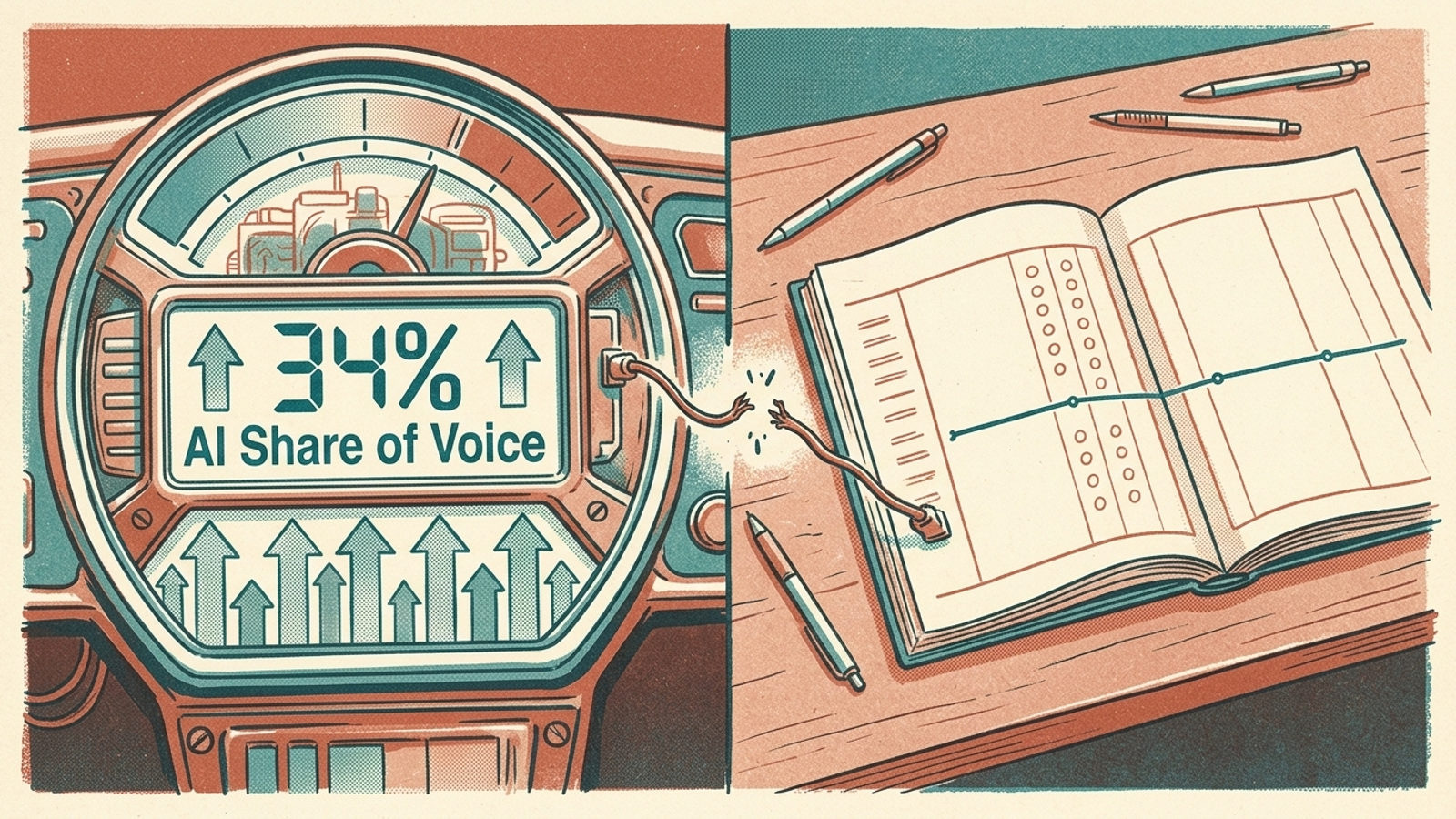
That percentage feels familiar to anyone who has read a paid search report. In Google Ads, Impression Share has a defensible denominator: the auction system knows the available search impressions for a targeted keyword. But as Search Engine Land noted, traditional share of voice relies on a fixed, known denominator of queries. The universe of conversational prompts is effectively infinite, personalized, and constantly shifting. A prompt list is a sample chosen by the vendor, not the market itself.
A big prompt set can still miss the buying question
That synthetic denominator often starts with your existing site. Vendors extract topics you already cover, turn them into test prompts, then reward you for appearing in answers about those topics. Next, they average results across engines into one blended number.
The blend conceals another difference. In a Yext study analyzing 6.8 million AI citations, Google Gemini drew 52.15% of its citations from brand-owned domains, while ChatGPT and Perplexity drew the vast majority from independent forums, media outlets, and third-party review sites. An average across those engines cannot tell you where your distribution is broken. Keep the results separate if you want to act on them.
Three ways the score misleads you
1. Padding the prompt set inflates the score
The easiest way to show a rising visibility line is to pack the test deck with questions nobody asks before buying. As Search Engine Journal highlighted, generating prompts from your own site creates circular confirmation bias: the tool tests whether an engine knows about concepts you already cover, not whether it recommends you to an uncommitted buyer.
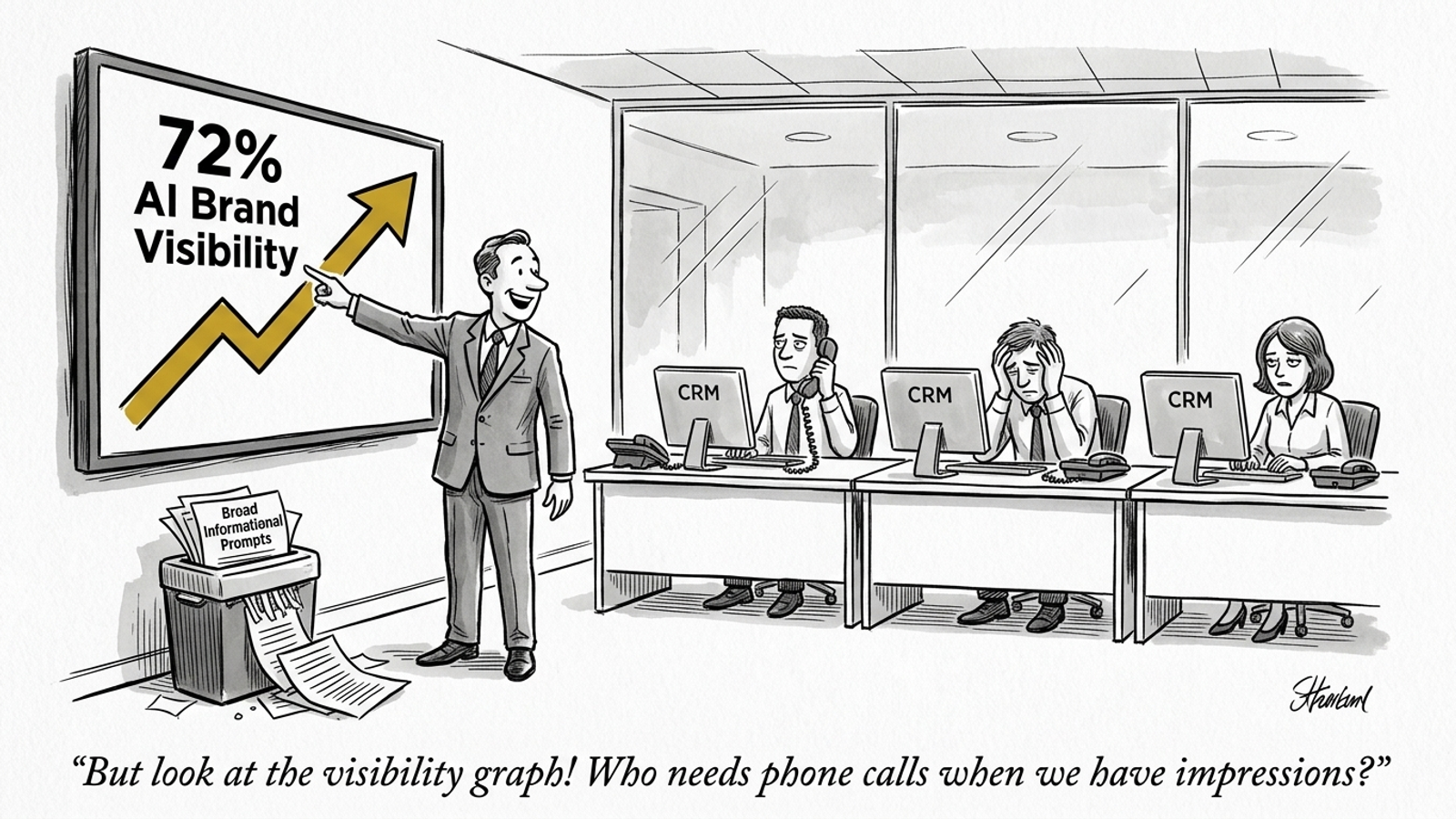
I saw the paid search version of this. Put budget into broad-match informational keywords or brand queries, then present a handsome Search Impression Share. The chart looked protected. The pipeline did not.
Say you sell warehouse management software. Tracking “what is warehouse management” 50 times across five engines can lift your composite score past 50%. Meanwhile, you might be absent from the prompt that matters to a buyer considering a $120,000 contract: “best warehouse management software for multi-facility 3PLs with automated cold storage.” The score can climb because you measured the easy questions more often. Check the buying questions first.
2. A mention is not a recommendation
Even on a relevant prompt, counting every appearance as an identical win is a mistake. As AirOps documented, an engine may name a company without a clickable source link. It may also cite that company’s technical documentation while recommending a competitor in the answer.
Imagine an executive asks for the best enterprise CRM. The answer names Salesforce and HubSpot as leaders, then says smaller tools like Acme CRM exist for budget-constrained teams. Acme’s dashboard records a brand appearance. The answer has just steered an enterprise buyer elsewhere. Record what the answer says about you, not merely whether it says your name.
3. One monthly sample mistakes drift for progress
Run the same query in ChatGPT three times and you may get three different answers with different sources. A monthly snapshot can turn that variability into a confident-looking trend. In a study tracking 82,619 prompts over 17 weeks, SISTRIX reported that Google replaced 56% of cited sources in AI Mode week over week, while ChatGPT replaced 74%. Secondary citations rotated at an 89% weekly churn rate.
If your score falls from 38% to 29% between March and April, your content did not necessarily get worse. You may have sampled a different answer. Repeat runs on a fixed set of prompts before treating movement as a diagnosis.
I’ve seen this movie: impressions, CTR, and Quality Score
Paid search has cycled through versions of this pitch. First came raw impressions and ad position. Then, as auctions tightened, decks leaned on Click-Through Rate and Quality Score. I watched technical metrics improve while the cost of acquiring a customer moved the wrong way. The client got a reassuring slide; the commercial problem stayed put.
Blended AI visibility dashboards offer the same comfort. When a channel feels chaotic, a clean line chart feels like control. But monitoring 1,000 prompts without acting on the answers does not grow a business. If a competitor replaces you on a valuable prompt, another alert is not the fix. You need to know which answer changed, what the engine used as evidence, and what work to ship next. Observation is not execution.
Measure the prompts that could lead to revenue
Build a panel of 20 to 50 buyer prompts
Replace the synthetic 1,000-prompt dashboard with 20 to 50 prompts that reflect how buyers evaluate your category. You do not need to know whether an engine mentions you in a historical summary of your sector. You need to know whether it recommends you when a VP of Operations asks: “Compare the top three warehouse automation platforms for multi-site logistics providers.”
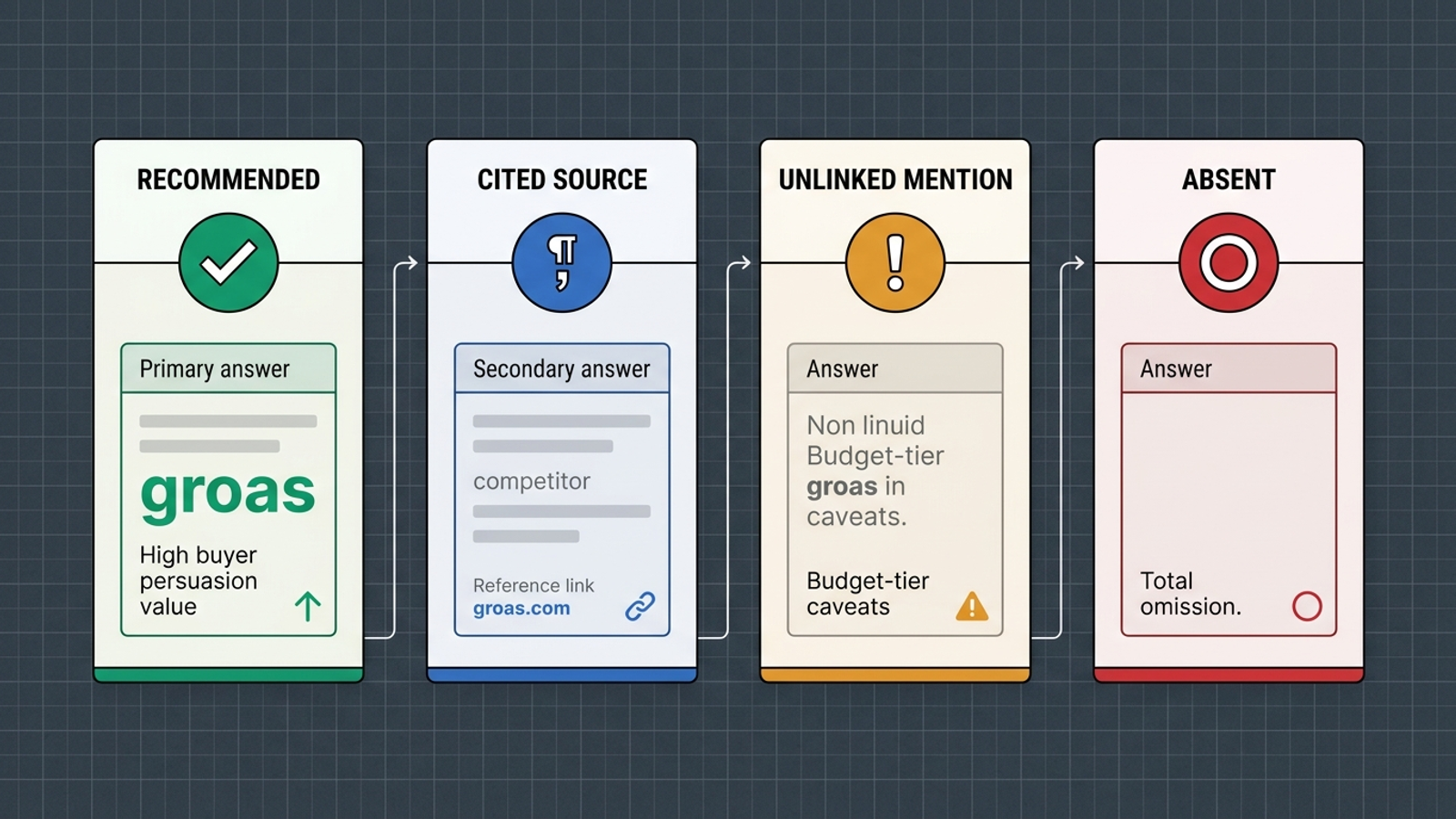
Weight those prompts by commercial value. If one relates to a $50 monthly subscription and another could precede a $60,000 annual contract, identical weight makes no sense. Then track each prompt by engine and classify the answer’s strongest useful signal for your brand:
- Recommended: The answer presents your product as an option for the buyer.
- Cited source: The answer links to your material but does not recommend your product.
- Unlinked mention: Your name appears without a supporting link or recommendation.
- Absent: Your brand does not appear.
Practitioners on r/SEO have argued for tracking a fixed panel across these concrete states instead of relying on an abstract percentage. Keep the underlying answer, too. A label should help you find the evidence, not replace reading it.
Follow referrals through to pipeline
The next measure is what buyers do after the answer: AI referral sessions, qualified pipeline, and closed-won revenue. AI referrals may look tiny beside traditional organic search. Across most commercial websites, they account for less than 1% of total sessions. Raw volume, though, is a poor reason to ignore what those visits produce. In an Ahrefs analysis of AI search conversions, AI search referrals generated 12.1% of customer signups while representing 0.5% of site traffic.
A buyer asking Claude or Perplexity for recommendations can arrive with a clearer purchase question than someone browsing a general search result. But if your analytics groups those visits under generic Direct or Referral traffic, you cannot connect the answer to what happened next. Set up custom channel groups for chatgpt.com, perplexity.ai, claude.ai, and gemini.google.com, then map those sessions to CRM opportunity creation and closed-won revenue. Otherwise, you are still measuring appearances with no view of the sale.
Log what shipped before the number moved
A buyer-prompt panel becomes useful when you connect changes in answers to changes in your work. Traditional SEO taught marketers to watch on-page keywords and backlinks. In an analysis of 250 million AI responses, Josh Blyskal found that traditional SEO metrics such as backlinks explained only 4% to 7% of AI citation variance, while 61.5% of citations came from third-party comparisons, review hubs, and independent discussions. A prompt result should send you looking at the sources and context behind that answer, not just at a site-level score.
This is where passive monitoring falls short. A tool can charge $500 a month to tell you ChatGPT stopped recommending your software three weeks ago. You get an alert and a red arrow. You still have to decide what content to revise, which technical obstacles to address, and how to respond before the missing recommendation costs you pipeline.
That is the distinction groas makes. It operates as a fully autonomous growth engine rather than a passive reporting layer: specialized AI models execute search work around the clock, while a named human strategist sets direction and owns accountability. The work and its reasoning go into an action log. The deliverable is not the warning; it is the work that follows it.
Who can keep the big score?
An enterprise consumer conglomerate with a nine-figure brand budget can use a broad visibility score as a directional measure of ambient presence. If millions of consumers ask general lifestyle questions, appearances across thousands of informational prompts may matter to that brand. It is buying cultural ubiquity, not managing an immediate customer acquisition cost.
For B2B software platforms, specialized ecommerce stores, professional service firms, and growth-stage companies with finite budgets, that is the wrong job for the metric. You cannot afford to pay an agency or software platform thousands each month to report that an engine mentions you in homework answers and introductory glossaries. If acquisition cost and qualified pipeline govern your decisions, buyer prompts must govern your AI search report.
The one-page monthly report I’d accept
Throw out the thirty-page deck. Ask your agency or growth lead for a one-page operating sheet with three parts:
- The buyer panel: Your 30 most valuable commercial prompts, tracked by engine as recommended, cited source, unlinked mention, or absent. Include repeated runs and the answers behind the labels.
- Attributable revenue: AI referral sessions, qualified pipeline, closed-won deals, and effective cost per acquisition.
- The execution log: Content revisions, schema implementations, technical fixes, and authority placements shipped during the cycle to address missing citations and recommendations.
If a vendor or in-house manager cannot show you that third part, cancel the subscription or replace the arrangement. A dashboard that spots a drop but leaves the fix to someone else is an expensive spectator ticket. Keep managing to the visibility score, and you can watch the line rise while buyers leave the answer without you.